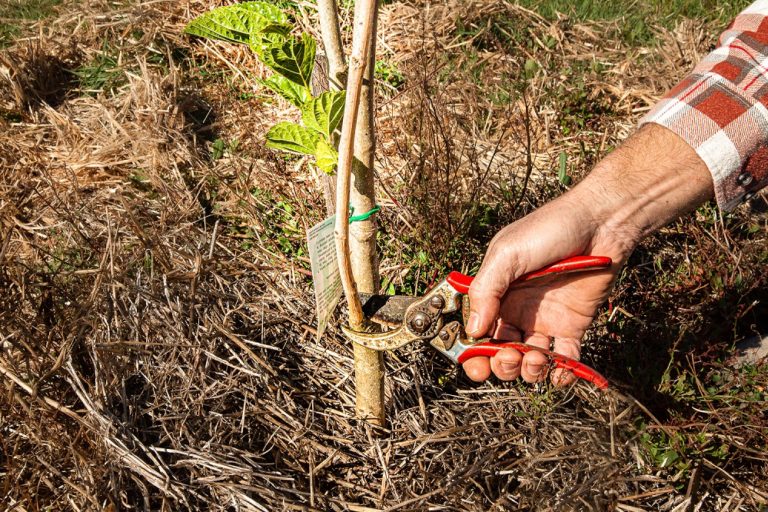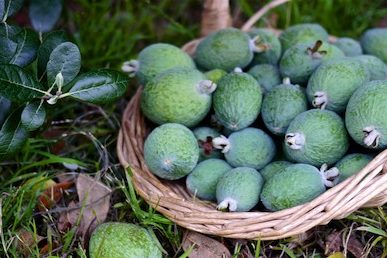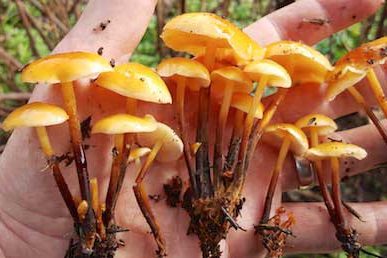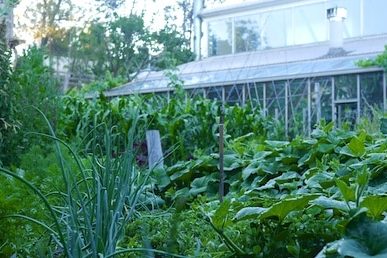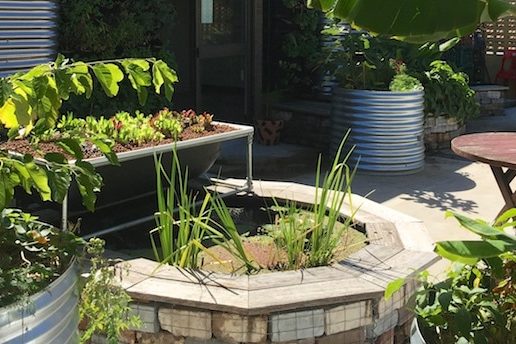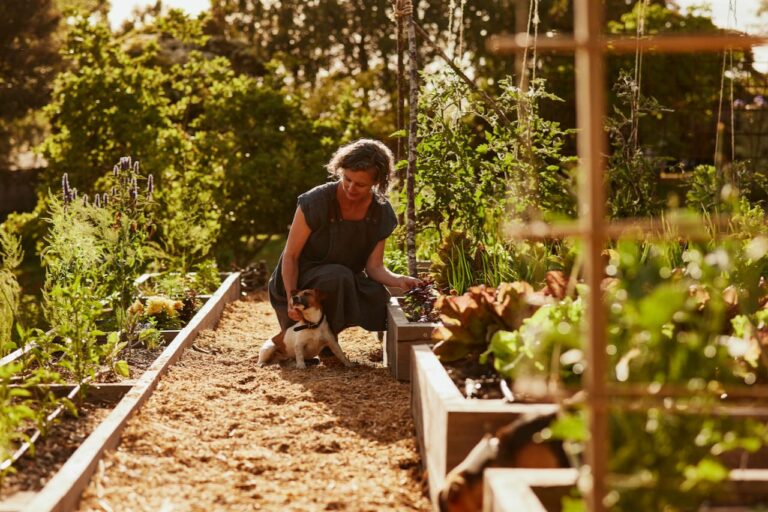
A guild, in permaculture terms, is usually used to define a harmonious assembly of species clustered around a central element (plant or animal) that acts in relation to this element to assist its health, aid our work in management, or buffer adverse environmental effects (Mollison, via Jacke).
Dave Jacke has taken this concept further and identifies a range of different types of guilds that generally (but not exclusively) can be applied to aid forest garden design process. Like many permaculture design elements, these guild types at once simple, and deeply complex… Read More »

We want the Holistic Orchard site at Milkwood Farm to be super productive, beautiful and also accessible – we’re establishing this orchard on a slope just below the Tiny House (and irrigating it with grey water) so we’ll be visiting it regularly.
And as I’ve mentioned, well designed paths can define and enhance a forest garden. And also make it much easier and more pleasurable to establish the whole thing. Which means you’re more likely to see the full establishment phase through, and end up with a glorious home orchard… Read More »

All around Milkwood are patches of dry-sclerophyll eucalypt forest. Variously called ‘goat country’ or other less attractive names, this type of forest is in a stagnant phase due to poor land use over the last 150 years.
Can you rehabilitate it into useful, productive land? Sure you can! While also generating plenty of useful material for posts, poles, firewood, mushroom substrate, charcoal, mulch &/or land repair and erosion control…. Read More »

Recently Nick was lucky enough to hang out with David Holmgren for a couple of days at Melliodora, the superb small-acre permaculture site that David has established with his partner Su Dennett in Hepburn Springs, Victoria.
Being in the thick of a super-productive, comfortable and energy efficient permaculture system at harvest time was inspiring, to say the least. To add to that, the purpose of the visit was for Dave Jacke to spend time with David and Su while he was in Australia. You can imagine the intensely wonderful conversations that went down! Read More »
February 12, 2013 – 7:00 am
Last week I talked to Dave Jacke (primary author of Edible Forest Gardens) about his upcoming Australian tour of talks and workshops. We talked about consciously designing gardens like forest ecosystems that maximise food production, for backyard scale and beyond. Have a listen!
We also talked about designing for resilience, and establishing perennial food, fibre and medicine producing systems that anticipate change in the climate, and everything that flows from that. Read More »
February 8, 2013 – 7:00 am

Sadly a ‘pig tractor’ as we know it is not a pig in a jaunty hat driving a little red tractor. But the reality is even better. It’s an excellent low-energy, high return way of preparing ground for a new garden or an orchard: removing all grass, roots and weeds with the aid of a biological device. Namely pigs.
We’re just about to finish the prep stage for our new holistic orchard, which the pig tractor has been a central part of. We’ve all been really happy with how prepping this space from tough pasture to fruit-tree ready ground has gone, so I wanted to share the process with you.
Pig tractors are relatively simple to set up (once you have your pigs) and the returns of this system are many. You get happy pigs being moved onto fresh ground regularly, snuffling and rooting up the ground. You get a tract of ground cleared of everything bar the shrubs (and the soil turned over to boot). You get added nutrient inputs from the pigs manure. And at the end of it all, you get pastured bacon. This just might be the ultimate integrated system. Read More »
February 6, 2013 – 7:22 pm

Milkwood are proud to announce Dave Jacke is coming to Australia in March to share his extensive knowledge in designing both urban and rural regenerative food, fiber and community systems, using forest ecologies as a model.
This is a special chance to learn from a world leading permaculturalist and forest ecology designer, thinker and teacher.

Dave Jacke’s Advanced Permaculture Design courses and his Forest Garden Design Intensives are somewhat legendary in the USA. However, in Australia he’s better known as the primary author of Edible Forest Gardens, a set of award winning books which encapsulate the theory and design of food forest garden systems.
Setting out strategies for designing food forest gardens for backyards, rooftops, homesteads and small farms, Edible Forest Gardens vol I & II are quoted as being the books that “will define the intellectual territory of its subject for at least a generation…” Read More »
November 30, 2012 – 7:00 am

Following on from designing a microforest garden recently, it was time to realise the design! Harris led the charge, helped by forest garden interns Minoru and Kelly, as well as all the students of the forest garden design course.
This micro forest garden was to be established on a very compacted piece of ground that had formerly been a road. Yikes. As with many plantings on this crazy patch of land of ours (read: everywhere except the creekflat), it was time to get out the crowbar to dig the holes… but it all turned out splendidly! Read More »
November 14, 2012 – 7:00 am

Urban forest gardens and food forests are definitely a part of our future cities – they have to be. We think every backyard should have a patch dedicated to perennial crops which interrelate as a stable and resilient system, while providing food, fruit and herbs for the household, hence our upcoming Urban Forest Garden workshop: 15 – 16 Dec: Sydney.
Micro forest gardens are a perfect way of achieving this goal. Essentially a food forest in miniature, a micro forest garden can be as small as one central fruit or nut tree with a complimentary guild of herbs and shrubs beneath it. You can stack a lot of nutrition into this kind of space if you design it right, and even slip some edible mushrooms in there too. Read More »
October 22, 2012 – 6:00 am

A microforest garden is usually something you would design for small-space forest gardens – for urban situations, or areas where space is at a premium. However they translate into larger forest garden designs as a nucleus forest garden, and can be a great way of starting a larger forest garden too.
To quote Dave Jacke: Technically, a forest is a large area of trees with interlocking crowns, and most forest gardens will not achieve the size and density to meet this guildeline. But we can still apply forest-gardening principles to very small spaces with one, two or three trees.
Recently at Milkwood Farm, Dan Harris Pascal led the design and implementation of a microforest garden as part of an Edible Forest Gardens design course, and now we have a kick-ass micro forest garden right outside the woolshed. Read More »