

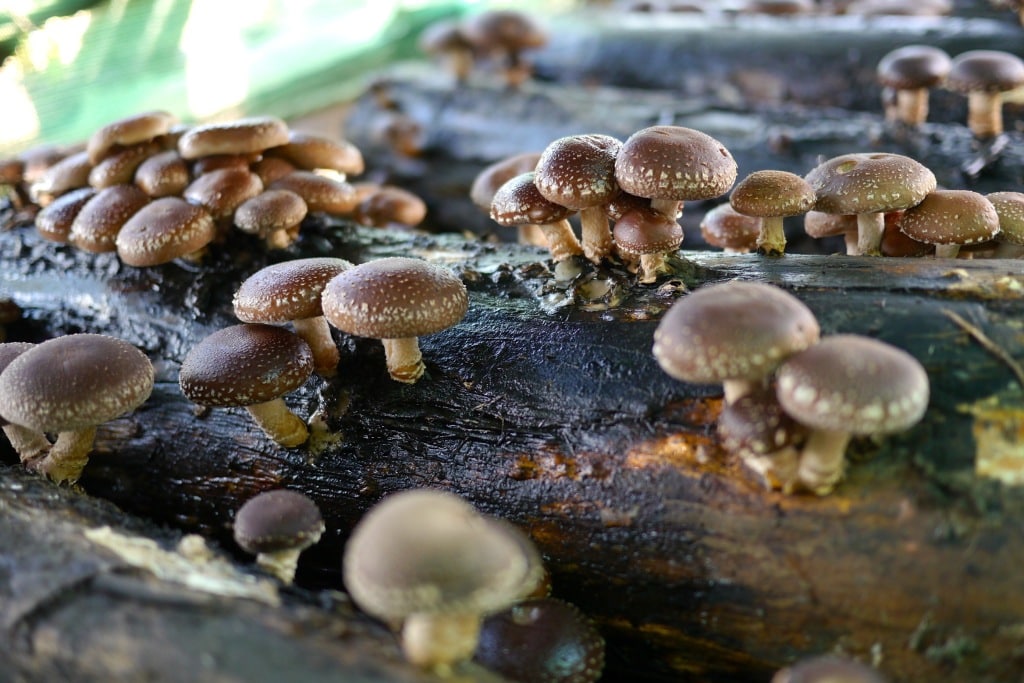
Shiitake mushrooms are the yummiest variety, in my opinion. They’re also the most expensive in the shops, and virtually impossible to find in an organic variety (at least where we live). Solution: grow your own.
You’ll be happy to hear that making your own shiitake mushroom log turns out to be very easy. It would make a great holiday project for any family, or a great skill-share workshop in your community. Here’s how you do it.
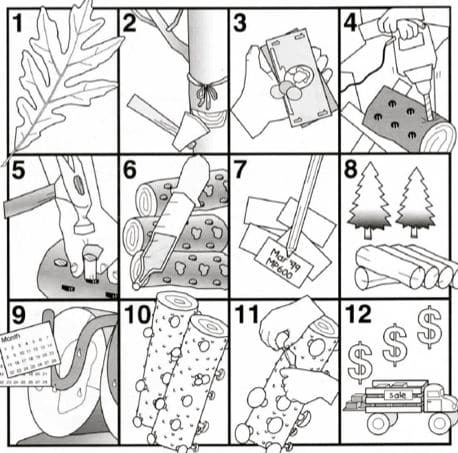
How to get rich quick by growing shiitake mushrooms. Or you could just eat them instead. Much better.
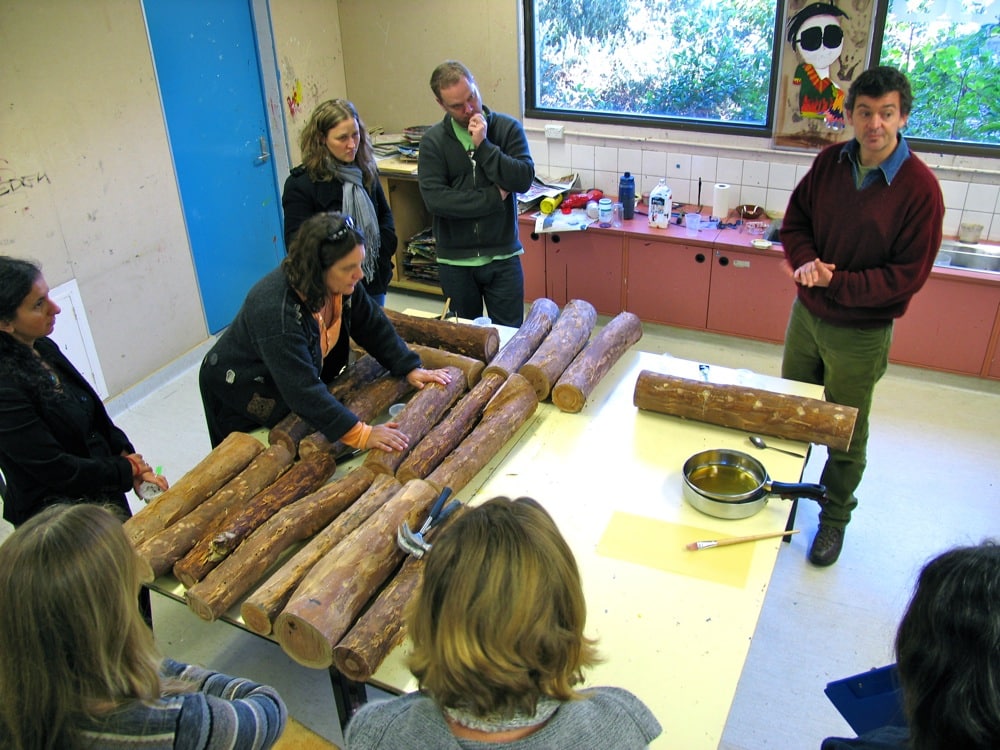
Ready to go…
We made our shiitake logs as part of a workshop we ran in Sydney recently…
Making a shiitake log: materials
- one freshly cut log (ideally 100-150mm in diameter)
- shiitake spawn (plug or sawdust)
- hand drill
- beeswax (organic, if you can)
- paintbrush
- a mallet – preferably with a rubber head
- heat source and saucepan
Making a shiitake mushroom log: method
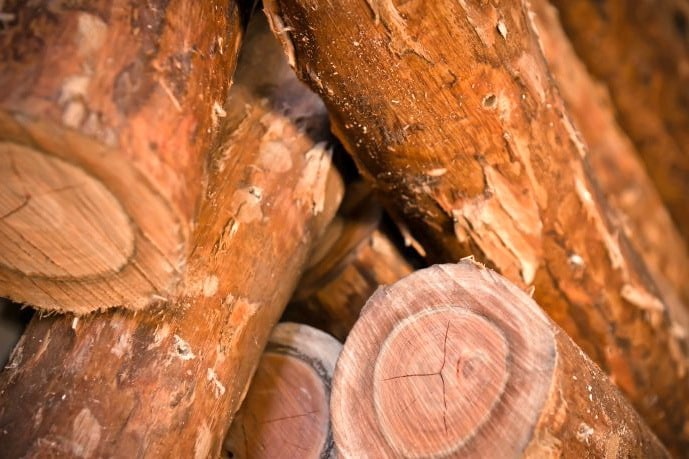
Our freshly-cut eucalypt logs, ready for action. Photo by Cathy x
The log: a freshly cut log is best, as this means other fungus haven’t yet had a chance to colonize it (and less competition means more shiitake mushrooms for you). ‘Fresh’ means cut in the last 72 hours or so. Apparently 100-150mm diameter is ideal, length preferably no less than 60 – 75cm.
You can use a variety of woods. We used eucalypt, and we de-barked them as they had thick, woody bark. If you log has thin bark, you wouldn’t need to do this.
The holes: we drilled each log with 20 holes, evenly spaced around the log, width 8.5mm if you’re using standard plug spawn – the diameter of the dowel plugs increases from swelling in the moist spawn environment.
If you’re using sawdust spawn, this might be different. You can get a small hand tool that injects a small chunk of sawdust spawn, for example, snugly into 12mm holes.
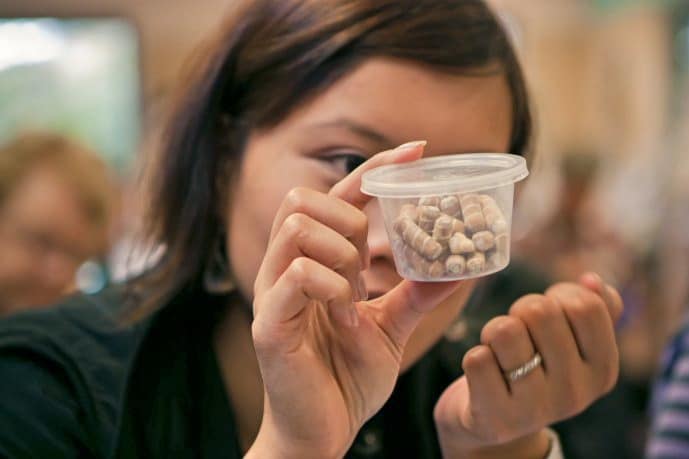
The shiitake plug spawn. Photo by Cathy x
The spawn: The basic idea here is to fill the holes in the log with shiitake spawn (mycelium). Plug spawn (shiitake spawn that has colonized a wooden plug) is one way of doing this. Colonizing sawdust with shiitake spawn, and putting that in the holes, is another way. We used plug spawn.
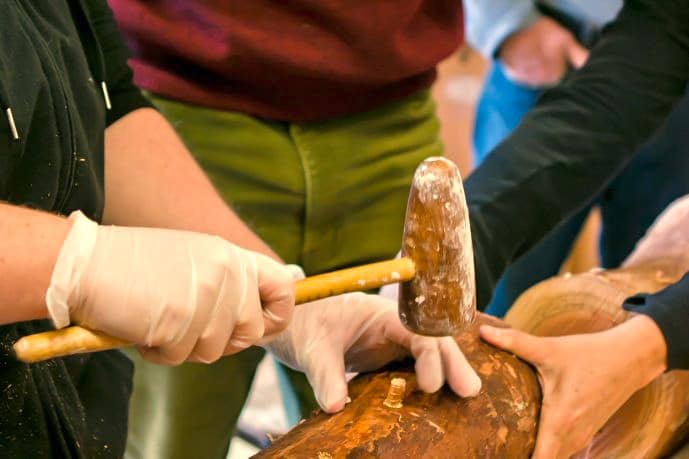
Tapping the plug spawn into the holes we drilled. Photo by Cathy x
Inoculating the log: This was the fun part. You take a spawn plug and tap it into the hole. Ta da! One innoculated log. Repeat until you run out of holes.
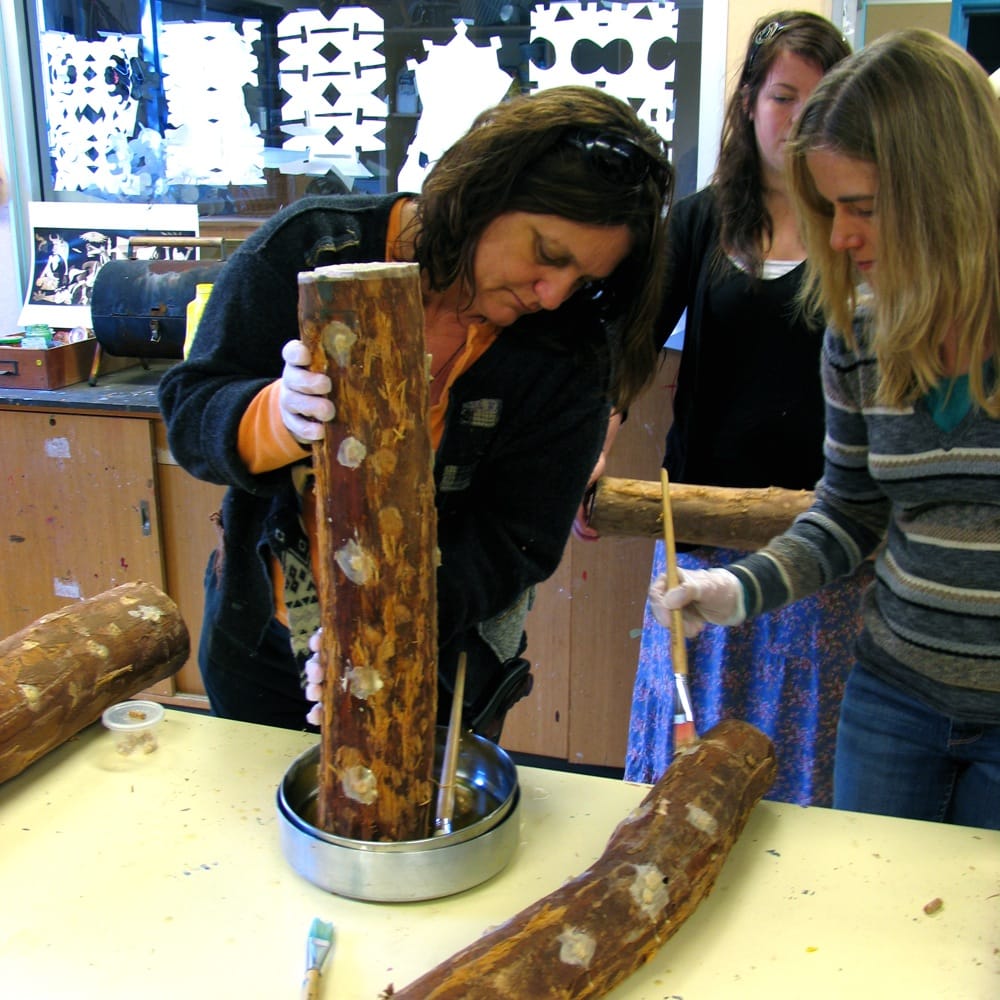
Sealing each end of the log with melted beeswax
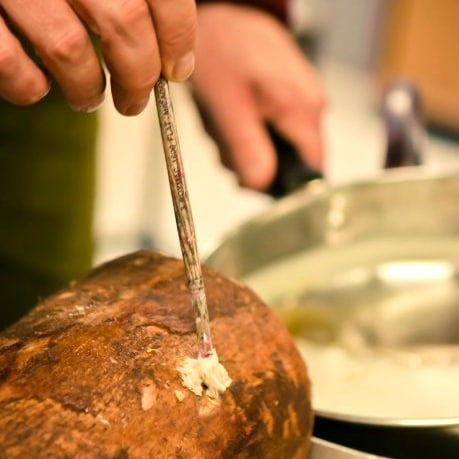
Painting beeswax onto the holes, with plug spawn inserted, to seal them. Photo by Cathy x
Sealing the log: this step is to ensure that you actually get a harvest of shiitakes, and not some other crazy fungi. To ensure that other fungi spores, which are always floating around in the air, don’t take over your carefully prepapred log and out-compete your shiitake spawn, you need to seal all open surfaces on the log.
The best way to seal the log is with beeswax, as it’s the most natural substance for the job. The mushrooms absorb whatever they come into contact with, so obviously you don’t want to use petroleum or artificially based waxes or sealants on your food.
In a perfect world you would use organic beeswax, as beeswax is a bio-accumulator for whatever toxins the bees have encountered (and most conventionally-managed bees encounter quite a bit, both in and out of the hive). If you can’t, just go with whatever beeswax you can get. It’s still the best option for this job.
So melt down some beeswax in a saucepan, and apply some anywhere the log has been penetrated. Don’t forget to seal each end of the log where it’s been cut, as well as each hole.
The knock-on effect: just before you site your log, give it a good bump and a whack. This stimulates the mycelium to proceed into a state which will result in a later ‘flush’ (blooming of mushrooms).
Which makes sense, when you think about it. This kind of mushroom grows on dead wood. Intrinsic to that wood becoming dead is it’s falling (a branch off a tree, or a trunk falling to the ground). In turn, this great big thump activates the mycelium. So you can simulate this by giving your log a thumping. Pretty cool, eh?
Siting your log: hurrah! Your log is now prepared. Now for the waiting bit. Take your log and put it somewhere with good airflow, preferably in semi-shade. Keeping it moist is good, but apparently the shiitake mushrooms will fruit even if the log is not constantly moist, it will just take longer. If you have a tree, put your log up in the branches, or close to the tree somehow. Make sure you keep it out of contact with the ground.
And in the space of 6-12 months, your log should look something like this:
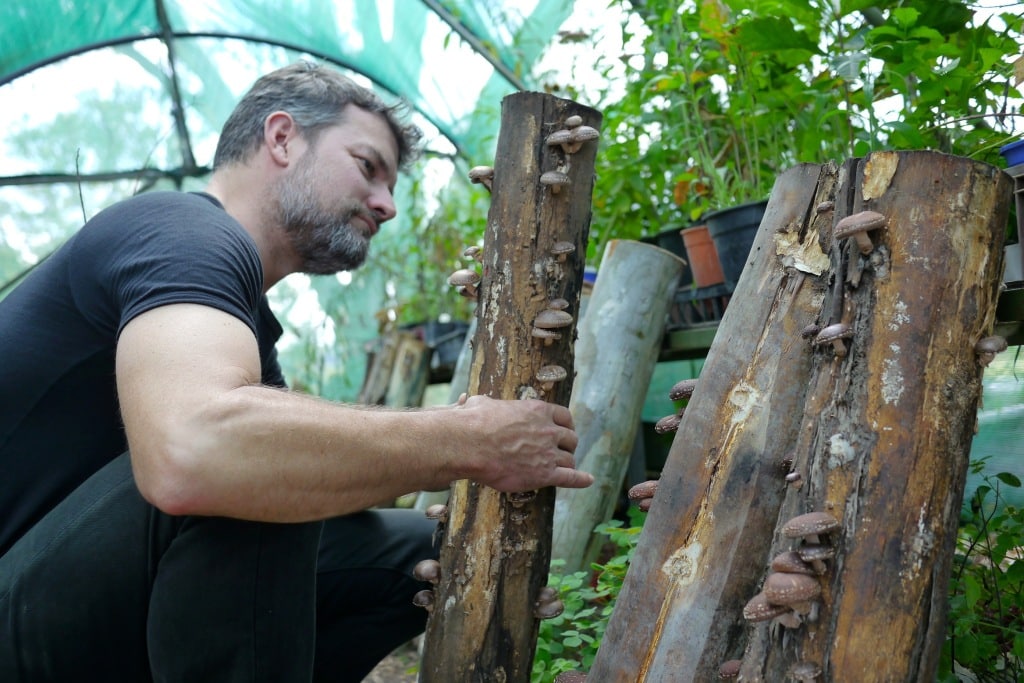
Harvest: your log should yield 5-6 ‘flushes’ or harvests following its first. Enjoy.
Resources:
- Shiitake Mushroom E-book – free and fabulous
- Shiitake propagation how-to – from Penn. State University
- Mycelium Running – by fungi master Paul Stamets. Great book.
Shiitake spawn suppliers:
- Milkwood mushroom spawn suppliers list
- Fungi Perfecti – Paul Stamet’s drool-worthy fungi enterprise (sadly doesn’t post to Australia)
Beeswax suppliers:
- Malfroy’s gold – Tim Malfroy supplies toxin-free beeswax of very high quality
- Stacks of Wax – Sydney domestic-scale beeswax supply
We run Mushroom Cultivation courses! Mostly in Sydney, if you’re wanting the learning, like.





WOW WOW WOW this is fabulous thankyou so much …. : )
Where do you get the spawn plug from??
we got ours from Will the teacher, but there’s suppliers at the bottom of this post.
Wow cool guys. Just saw these for sale in local health food shop for £20 so making my own sounds much better.
There is a new forum for Australian Mushroom enthusiasts
http://www.ediblemushroom.net/index.php
Join in and get growing!
Cool! Thanks, Will. Will spread the word 🙂
Hello… I’m looking into growing mushrooms on my farm. The ambition is to start on a small scale and work my up to a point to where it’s a full time job. Have done a bit of research on different types of mushrooms but not sure which type I should start trailing. I’m figuring that buying a mushroom kit and doing a shiitake mushroom log would be a good way of starting.
Any feedback with thoughts and ideas would greatly be appreciated.
Regards
Glenn
Hi Glen, Yep start with oyster mushrooms (easiest) and shiitakes…
Its nearly a year now since I inoculated my logs that were sourced from the great WA storm of June 13th 2012. I chose eucalypts with fine smooth bark & used shiitake dowels. The logs have been kept horizontally on a steel frame in part summer shade, full winter! They were mist watered most days during the heat! The bark is currently falling of the logs leaving the end of dowels proud of the timber! As yet there are no signs of mushrooms so what do you believe are my chances at this late stage?
Reblogged this on Planète autonome and commented:
Une autre chose à essayer…
Hiya. The handbook link no longer works. There seem to be a lot of Shiitake Growing Handbooks out there – which is the one you recommend?
Love all the pictures of what you have been doing.
Thanks
Col
Hey great article! I’m really keen to give this a go, except I’m not sure at what time of the year this should be done…
Hey Linda, you can start shiitake logs off at any time of year, if you have the ability to keep them somewhere cool and damp-ish? otherwise, Autumn is best…