
 Wendell Berry once said if you eat, you’re involved. He was talking about agriculture, but if you ask me, he really meant humanure. Getting your outputs sorted is a big and necessary task. For us, that meant designing and implementing a composting toilet system based on wheelie bins.
I thought I’d better give out the details of our compost toilet bin system, as we’re receiving many emails asking for the specifics of how the system fits together. It’s a simple design, but one that we’re very happy with. Here’s how the bins work:
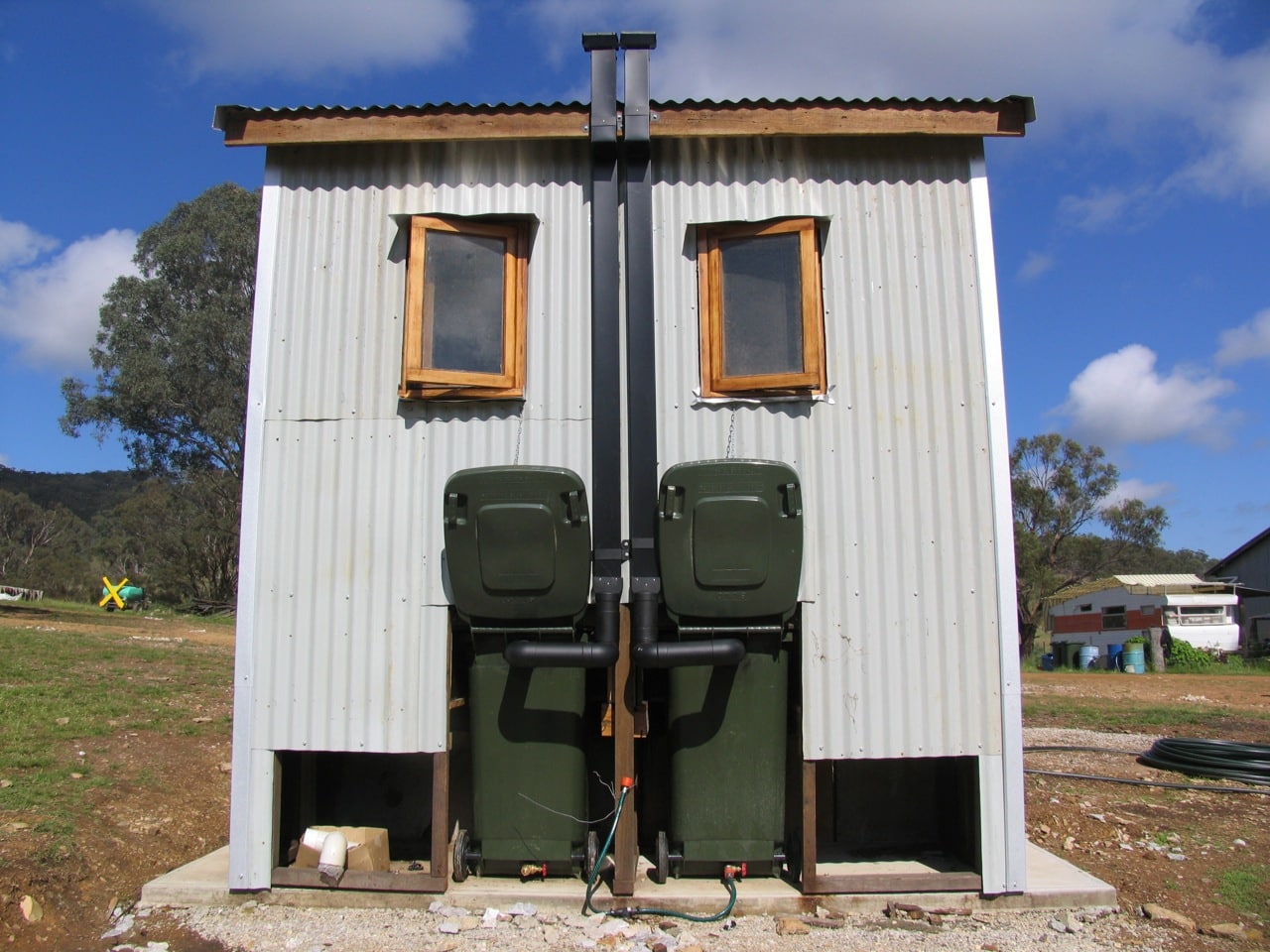
The back of the toilet block showing chimney attached to each vent at the back of each bin. Click to enlarge.
The whole point of having these bins as our composting toilet system was to remove the need to handle the humanure until it had gone through its composting process and was safe to handle. We’re fine with handling open buckets of our own family’s sawdust-covered poo within a small humanure toilet system, but when we have a course here at Milkwood we can have up to 70 people on the farm each day. And though I value their presence (and their poo) I prefer not to process their collective contributions while they’re fresh, if i can avoid it.
So the bins are our solution. When one fills up, you roll it out, stand it aside in the sun, roll another empty in, lock it into place and continue on. No bucket handling, no processing. And a year later, each full bin has transformed into a rich, safe humus, ready to be added to the rootzone of our food forest trees. We label each full bin so we have a full inventory of when each lot of humanure will be ready to use.
The bins we’re using are normal 200 litre wheelie bins, used for household rubbish in Australia. We add a vent at the top of the back panel, a tap outlet at the bottom of the back panel, and a grate inside the bin. Each bin takes about 1 hour to prepare all up, and are best done as a batch. Once a bin is adapted, you’ve got it adapted for life, so it’s a worthy time investment.
The Grate
Each compost toilet bin has a home-made grate in them which sits about 5cm off the bottom of the bin. This grate provides a permeable barrier between the solids and woodchips coming into the bin, and the bottom of the bin reservoir. Any liquid (and there isn’t much, as the woodchips absorb most of it) moves through this grate and fills the bottom of the bin, and then drains out the bottom through the tap.
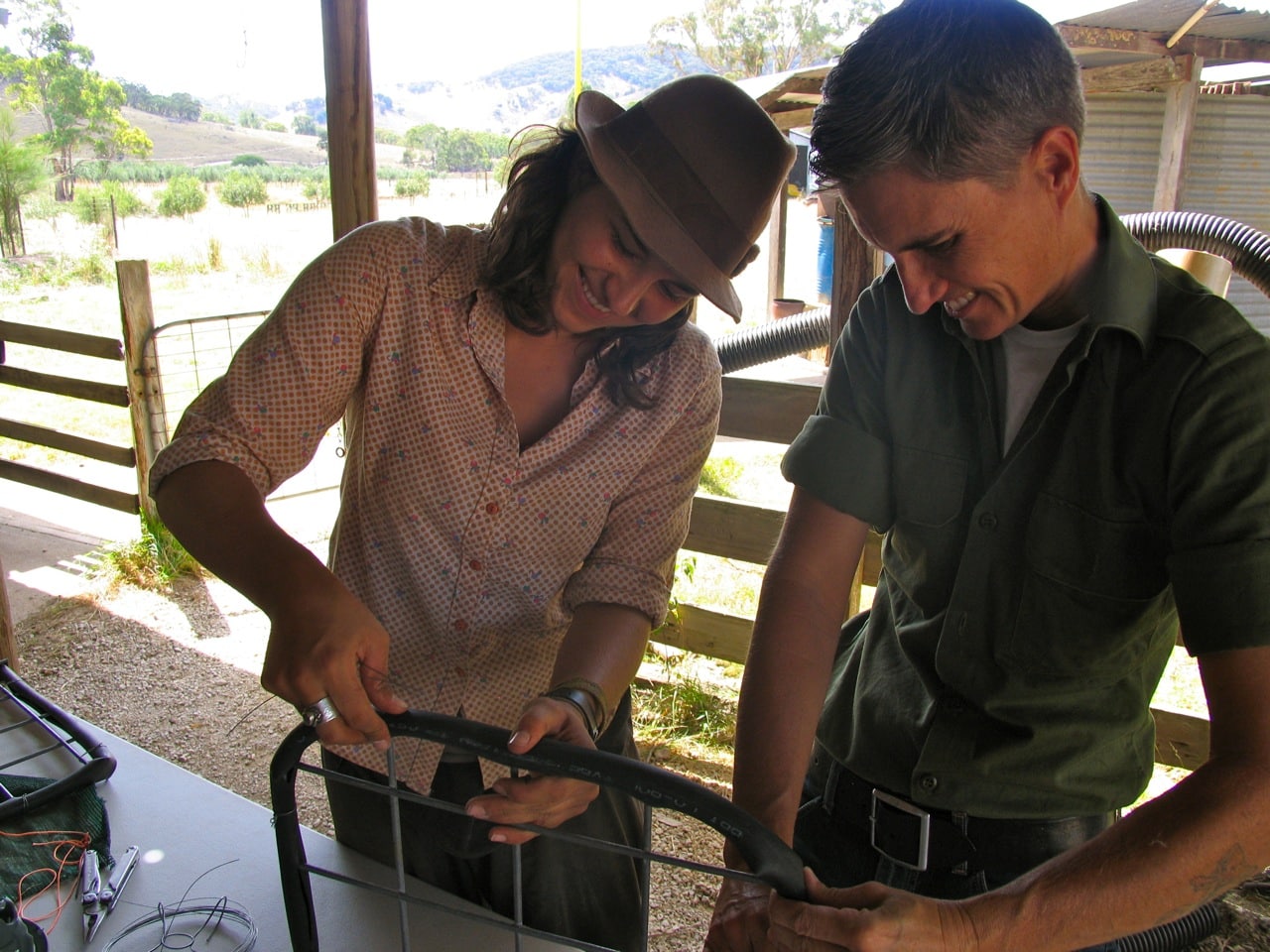
The grates were made by cutting a piece of galvanised steel mesh to size, and then adding a polyethylene surround (19mm low density irrigation pipe) to the mesh and wiring it on. A shadecloth cover is then tied to the grate to filter finer particles. The finished grate is wired to 4 bar chairs (the little plastic cones that support rebar while concrete is being poured), which raise it off the bottom of the bin. The completed grate can then be placed inside the bin, and can be removed easily when the humanure is used at the end of it’s composting cycle.
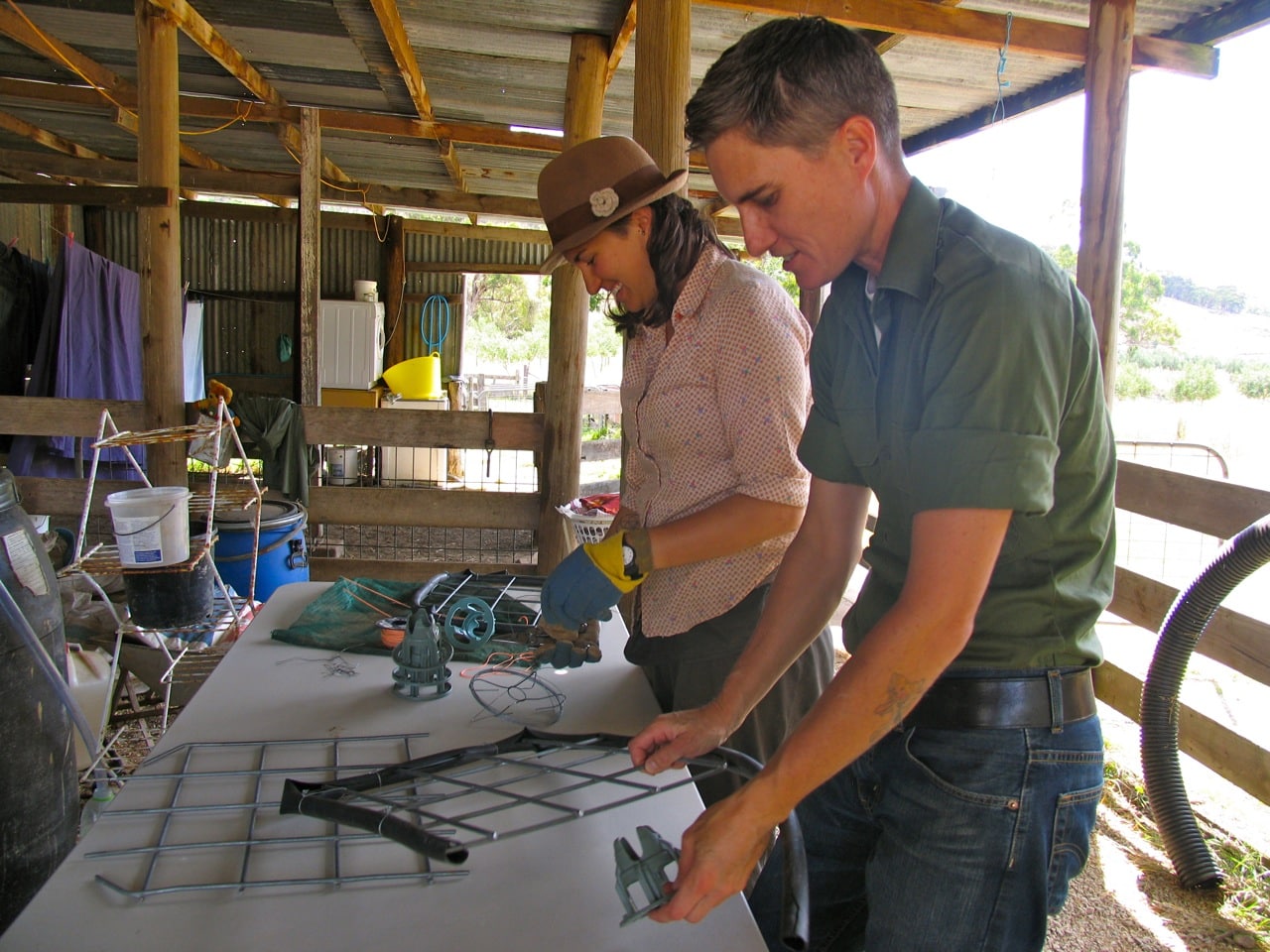
Milkwood interns Bel and Kade adding PE surrounds to the grates
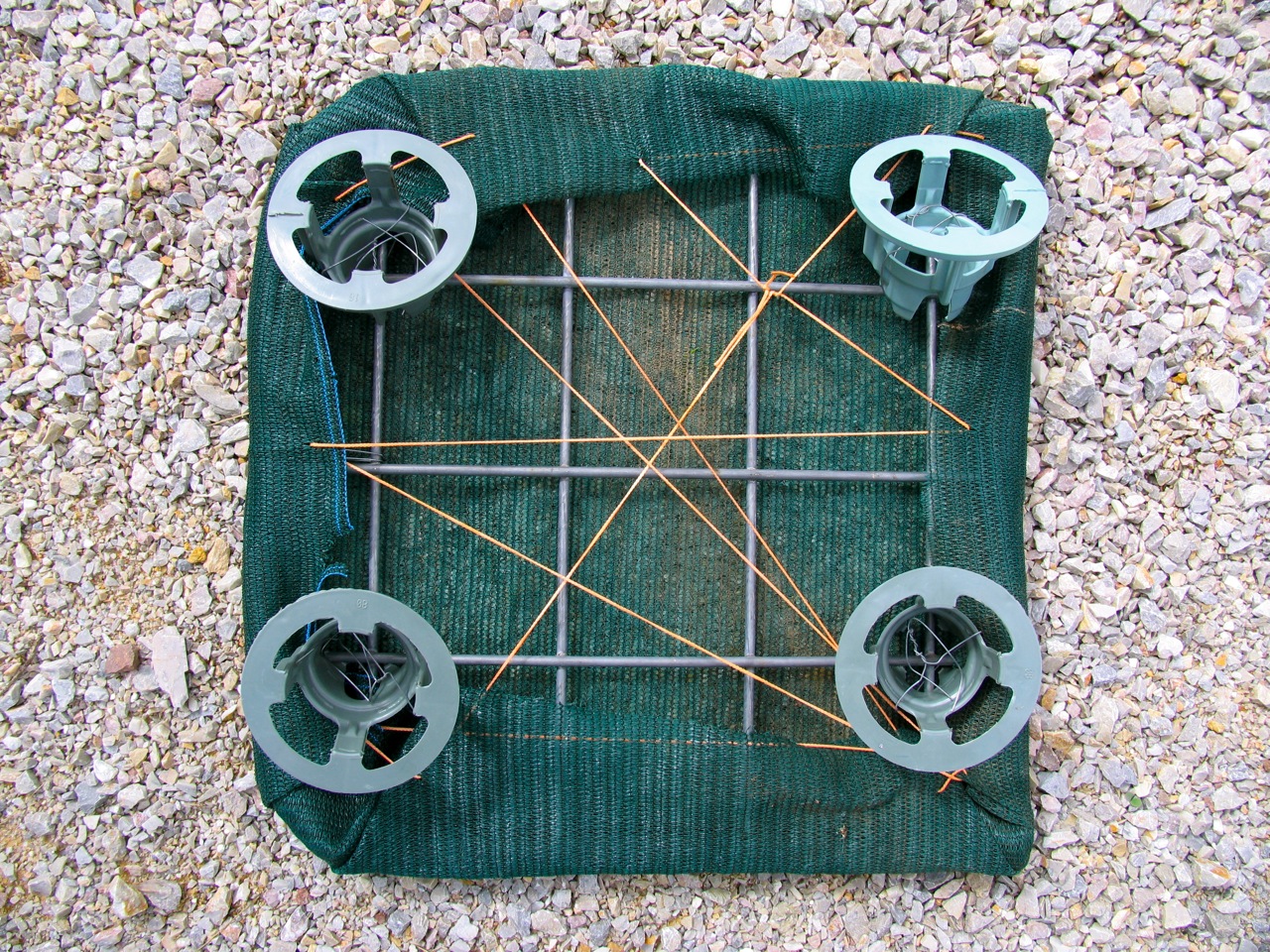
Completed grate, shown upside down. Note detailed and professional shade-cloth attachment with crazy string
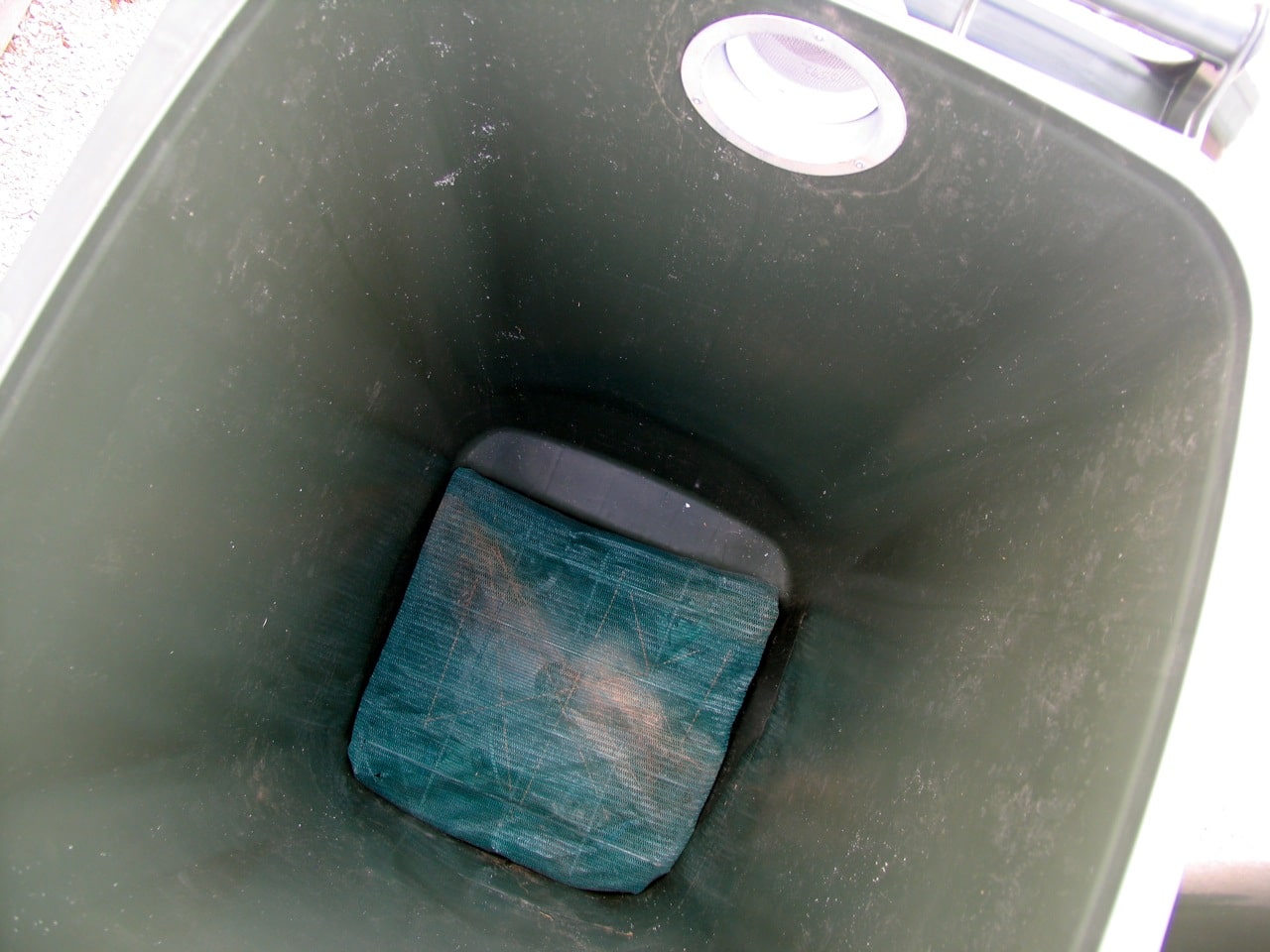
Grate in place in bin.
The Tap
The tap is very basic (tank flange – gate valve – snap on hose fitting) , and it’s construction is pretty obvious. The only hard part is climbing into the bin to attach the flange. We place a screen of shadecloth over the inlet pipe, so solids don’t stop up the tap. The tap mechanism is very important as it prevents the bin from flooding with liquid. Flooding the bin would drastically increase it’s weight and will make the bin anaerobic, which stinks and looses lots of nitrogen.
When the bin is in use, the tap is then attached to a leachate hose (and turned on) which drains the liquids to a gravel-filled leachate pit (not dissimilar to the idea of a septic overflow, except there is much less liquid in this system). We planted twisted willows on our leachate pit (which are thriving with the extra nutrient) to supply our rocket powered shower down the hill with stickwood and for carbon rich autumn leaves for our compost. Every output can be an input.
Once the bin is in processing mode (ie full, and sitting in the sun) the tap is closed. With the internal temperature of the bin getting up to 70ºc during processing, any liquid in the bottom will evaporate back into the bin’s contents.
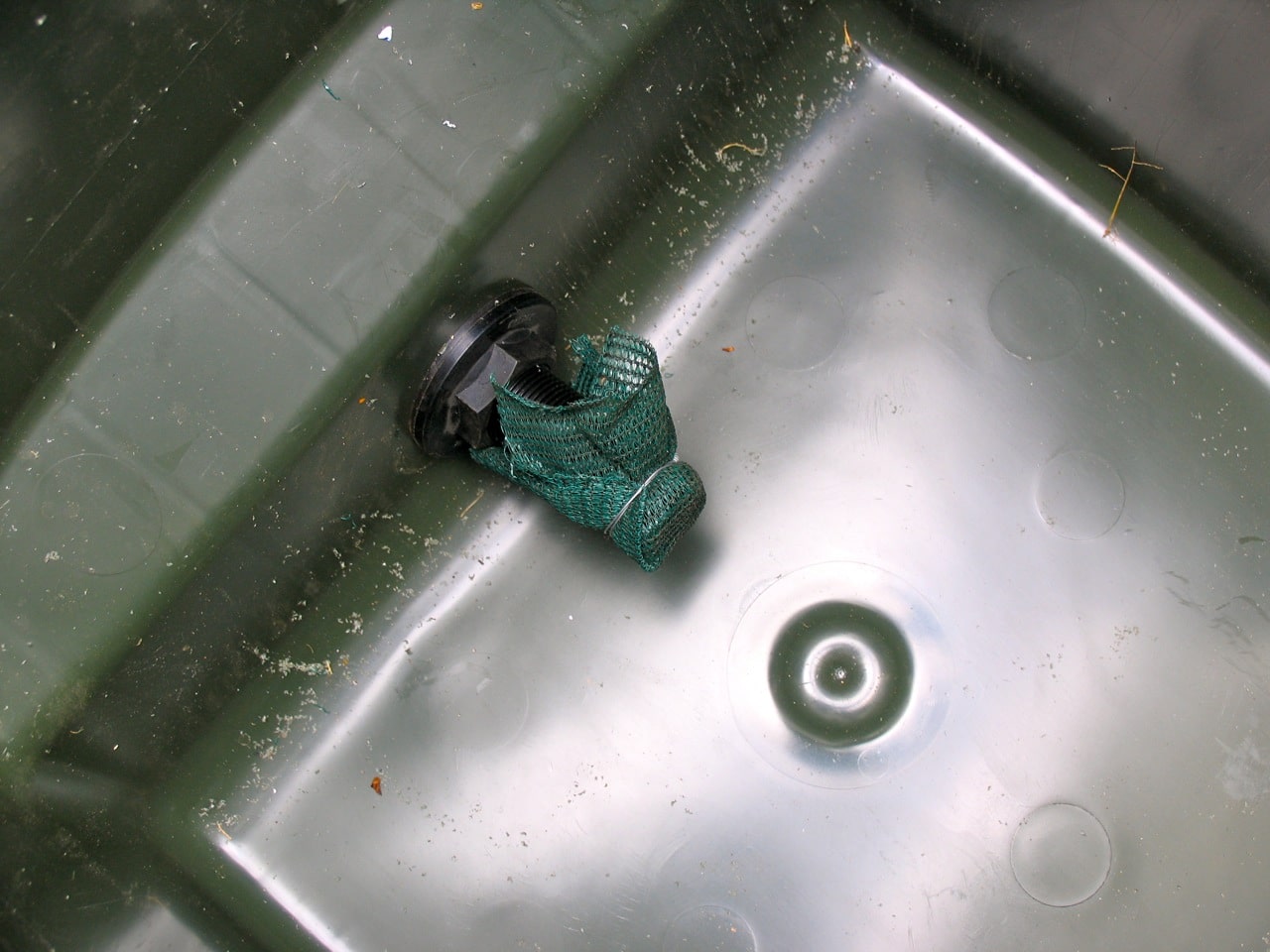
inlet pipe wrapped and ready to take on all solids (and liquids)
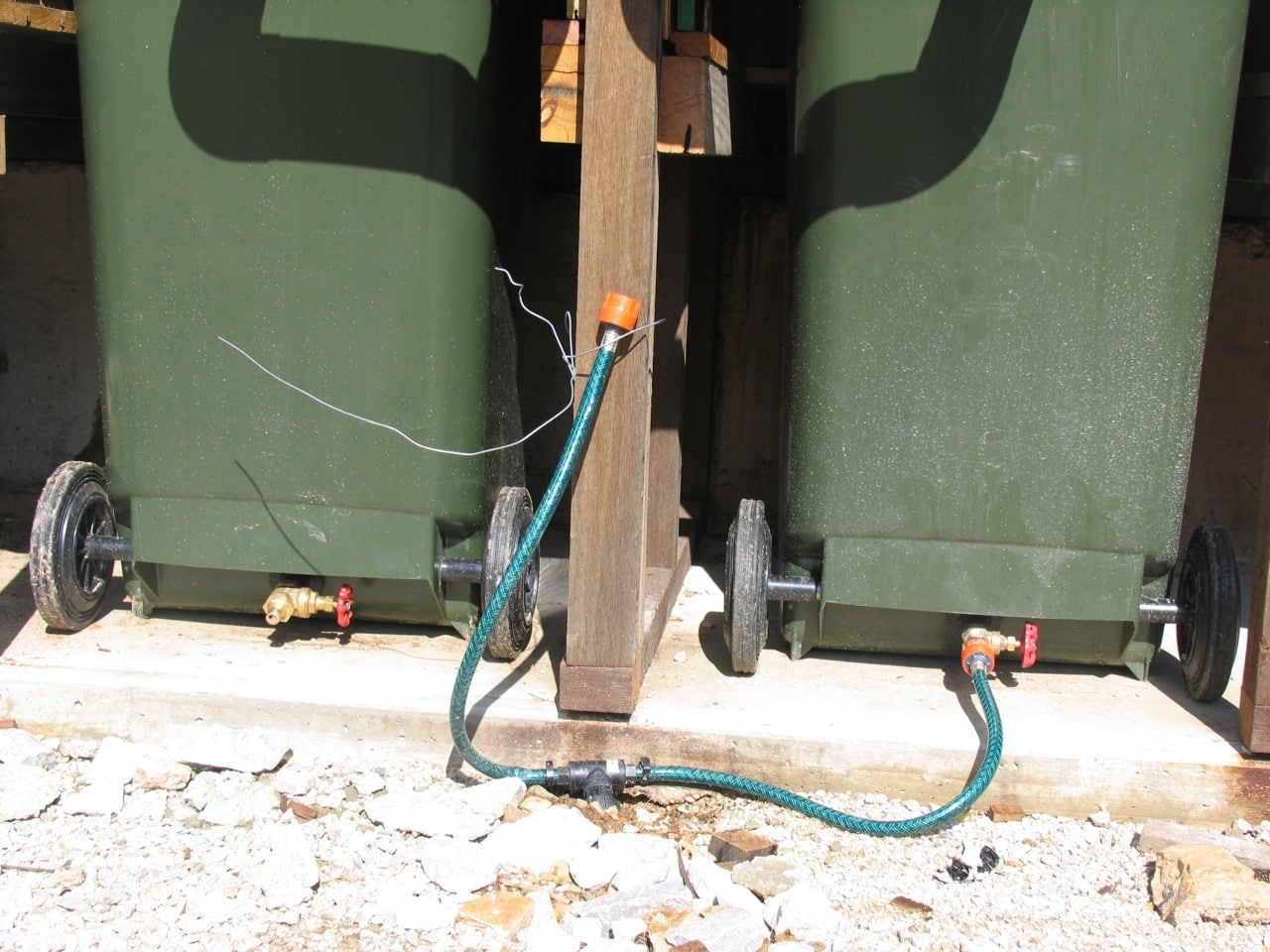
taps and hose to take the liquids to the pit
The vent
The vent is at the top of the back panel of the bin. It’s a simple rainwater tank overflow screen riveted to gutter outlet (sourced from the local hardware), rivieted into a hole in the panel. The outside edge of this vent attaches to the chimney which draws air up and out of the bin. The suck is created by the heat generated by the morning sun hitting the black metal chimney and this additional airflow means that the toilet cubicle always smells pleasant, as any odours in the bin are being sucked away.
This airflow also dries out the bin’s contents a little bit, which is great. And the mesh on the vent means no flies get into the bin from inside the chimney.
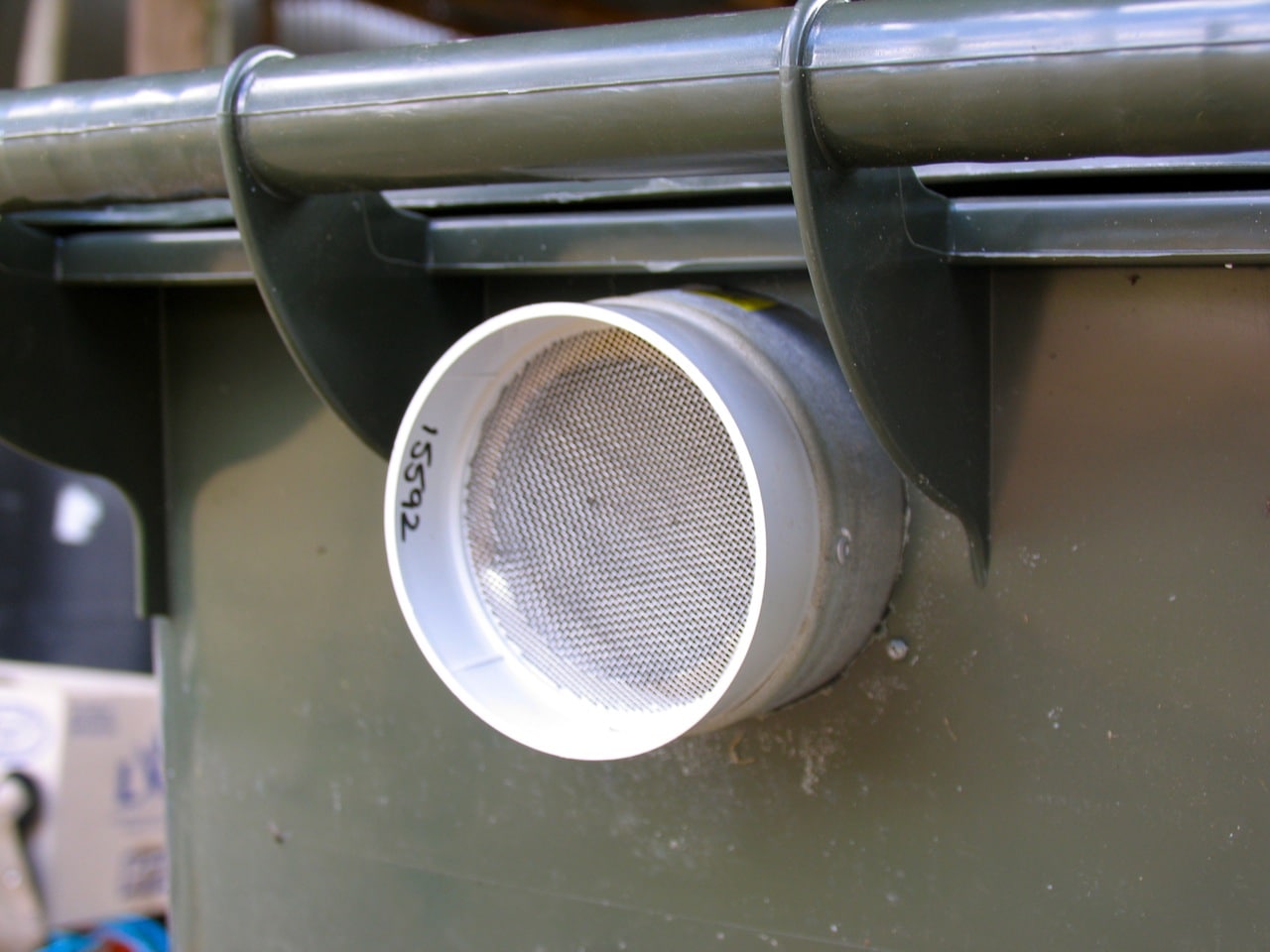
Vent from the outside. Simple but effective.
The back of the toilet block showing chimney attached to each vent at the back of each bin. Click to enlarge.
Other considerations
We’ve started adding rock dusts to the bucket of woodchips provided in the toilet cubicles. These will help incrementally re-mineralise our land over time, as the humanure gets used around Milkwood. The rock dusts also create a more interesting humus makeup for the microbiology which will move into the humanure in time.
After the bin has been removed for about a month we also throw a handful of worm castings (full of worms and worm eggs) into the bin to increase the diversity of microbes and to start a population of worms breeding. High rise living for worms!!
We’ve hit on using metal plant tags, wired to each bin as it comes ‘out of service’, so we can track which bins are what ‘vintage’. We write the month and the year on the tag, so we know not to use that bin’s humanure for at least 1 year.
These compost toilets are proving a marvelous solution to all the bits we can’t feed to the chickens, or don’t want to add to a compost heap because of inquisitive dogs: chicken bones, dead rats, oversupplies of orange peel and so on. It’s good to have a nearby and useful place to put these things, rather than having to bury them and take them out of our active nutrient cycles.
We’re fairly sure we’ve calculated how many days it takes to fill a wheelie bin under normal usage: 150 person days – so one person with a normal digestion would take about 150 days to fill a single bin by themselves (and 6 people would take 25 days to fill a single bin, and so on). Using this rough guide we can now plan ahead for when we need to modify more bins. It will be good in the second year of this system, when we start to re-use the cleaned bins, but we ain’t there yet!

The back of the toilet block, with a neat array of bins – some full, some empty.
So that’s that. 5 months in and we’re still really happy with this compost toilet system for all sorts of reasons (though I’m sure there’s still room for improvement). If you are completely confused at this point, hop over to our description of our composting toilet system, or have a look at Jenkins’ Humanure website. You’ll get the gist.
You might also like to read:
- More of our posts about humanure
- How to build a worm tower
- Our slightly silly ‘how to make compost’ videos