

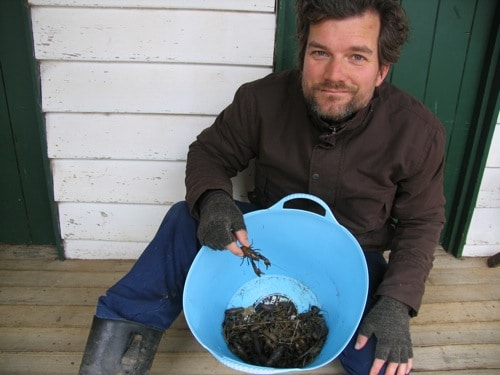
Recently we’ve un-ravelled one of the mysteries of nature that’s been plaguing us for years here at Milkwood. How is it that if you build a dam or a pond, in the middle of nowhere, that over time it naturally becomes inhabited with water-loving creatures like yabbies? How do they know the new water source is there? Can they smell it? Is there some sort of inter-species bush telegraph? This one really had us stumped.
But now, we’ve seen it for ourselves, so we can tell you too. In certain conditions, the yabbies just walk there.
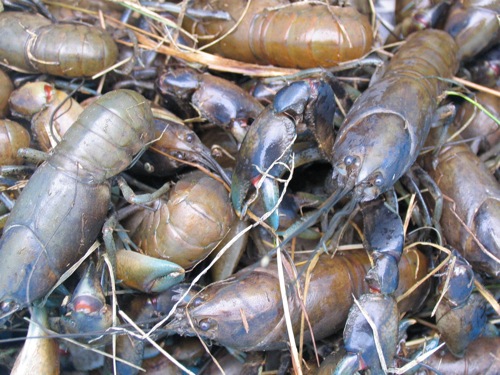
Yabbies. Lots of em!
Last summer, when everything here was dried to a crisp in the drought, we were trying to imagine how the heck critters like yabbies, turtles and so on move from place to place. In high summer, I can’t imagine a water-dweller would strike out across a paddock or up a hillside in the hope of finding a new pond to inhabit. They’d be dried to a crisp in a second or two. And then, in winter, it would be so cold they might freeze before they got there…
But in retrospect it all seems so obvious and, as usual, so elegantly designed. Here’s how we’ve seen it work with yabbies: in big rain events, catchments like ponds and dams overflow. This overflow trickles downhill to the next water catchment, which might be another pond, or perhaps a creek. If there are yabbies in the lower catchment, and those yabbies are feeling adventurous (for whatever biological reason), those yabbies may judge that overflow to be worthy of following up to its source, which, i suppose they are betting, is another pocket of water suitable for them to inhabit.
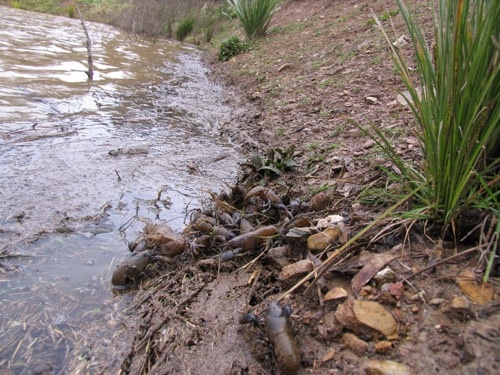
The yabbies at their chosen point of exit from the creek – they’ll follow the waterflow up the bank and across the paddock to the source
In the case of the overflow from our bottom dam to our creek, the yabbies had chosen well. If they could make it out of the creek, up the bank, across the creekflat and up to the source of the overflow they would have the run of the largest dam on our property. Lots of room for everyone. However (and here I am trying not to channel David Attenborough -esque narration), their journey was not to be an easy one…
Firstly the yabbies had to get past the currawongs, who were picking them off as they made it up the steep bank of the creek and onto the creekflat. It was a bit of a free smorgasboard for the currawongs – they were all hopping about, looking very pleased. The yabbies also had to get past the grey herons, similarly engaged. And then, of course, the yabbies had to get past Nick.
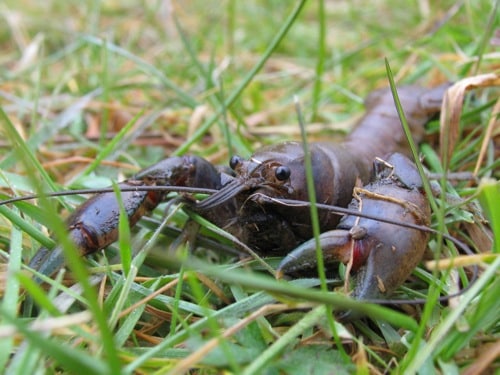
A yabbie in progress across our creekflat, on its way up to our bottom dam
Nick, splashing about in the rain, was admiring our newly filled dams with their perfectly re-set spillways. Going down to the creekflat to see what all those currawongs were doing hopping about, he discovered the march of the yabbies. Being the helpful soul he is, Nick of course went and got a bucket, collected all the yabbies he could find marching (slowly) across the grass, and generously delivered them to the dam above.
The geese were too busy rejoicing in the rain to notice their new neighbours arrive, but as they eat mostly grass I can’t imagine they’ll be too fussed. A good spring should see a nice big yabby harvest for summer solstice. Or perhaps make that next summer solstice, depending on how long they’ll take to grow.
Even if we don’t get a yabby harvest this year, at least we’ve added to the biodiversity of Milkwood. And we solved a mystery, all in one rainy day.
[slideshow]









how cool! we lost all the lovely yabbies that inhabited our little creek when it dried out the summer before last…. I’ve been lamenting that perhaps I’ll never spy a yabby in the creek again…… but now you’ve given me renewed hope! fingers crossed that we’ll get some more rain and some more yabbies!
cheers from sams creek
ronnie
i love this story. it’s just great that you have made a setup which allows you to have time to observes something so wonderful and fun!
Hurrah! All hail the kings of crustecea! Far better than anything Europe has to offer (take THAT, o Dublin Bay Prawns…)
Importantly: how do you like to cook them?
I have just found a poncy recipe for Trout Mousseline and Yabby Sauce in an old copy of Gourmet Traveller in Sale Library, if you’re feeling upmarket!!!
Hey Sis! Actually I have no idea how to cook them but I’m sure we’ll figure that out as we go. Simply, with herb butter on the side, I’d say. And with a fabulous local bottle of something…
so kirsten, to get the muddy taste out of the yabbies leave them alive in a bucket of fresh water -not too full otherwise they climb out- for a couple of days.
they would taste much better after that rinse!
🙂
ideally, put them in a big tub of fresh water and some nice greens(?). Refreshing the water and or aeration might be a good idea.
You can boil them to cook them. Very nice.
Cook them like mud crabs with some salt in the pot, until the shells go red. DONT overcook. Either kill them with a spike (better)or stun them in cold water. I have read that placing in a freezer (particularly so with reptiles) can be agonising for them. We experimented with tiny yabbies like yours from a large dam (interestingly the creeks around my place in Sydney have always – 30+ years anyway – had yabbies easily 40-50cm long but tempting though it is I will not kill them). We found the small dam ones to taste very muddy – which… Read more »
You can improve the taste significantly if you remove the ‘food tube’ before cooking. To do this you twist the middle section at the end of the tail and, delicately, pull the ‘food tube’away with the tail section in one job lot. Remenber though, its just the very middle ‘fin’ at the end of their tail that needs removing.
Cheers
I’m sorry m8 but this is only one of two ways the yabbies ” appear” in dams in the middle of nowhere, 50km – 150km – 200km to the nearest source of water when people build they’re own dam… I am glad you saw for yourself 1 of the 2 reasons yabbies will “appear” when a dam is built, but it is well established and pre proven ( not to take your glory away) to those of us grown up of the country and it’s teachings that yabbie migration occurs… However there is no possible way for yabbies to be… Read more »
The main reason yabbies left my tank was lack of food… Fix that problem and they are happy in any reasonably sized clean body of water. They will walk freely overland and seem to have an incredible ability to walk toward the nearest source of water… They always went north toward our usually damp swale… This habbit made it reasonably easy to locate any escapees… However they dehydrate quickly though and that is a very big limiting factor on their ability to move. I’d suggest they move with high humidity and after rain. They will only survive in dams that… Read more »
But what if there is no creek nearby? Then where do they come from?
Oops….Sorry…strike my last comment. I have just read ‘Yabbiefarmer’s piece which explains it wonderfully. Very helpful and informative. Thank you.